

Homesteading Women Were Stronger Than You Think
Women on 19th-century homesteads defied narrow gender stereotypes in favor of survival.

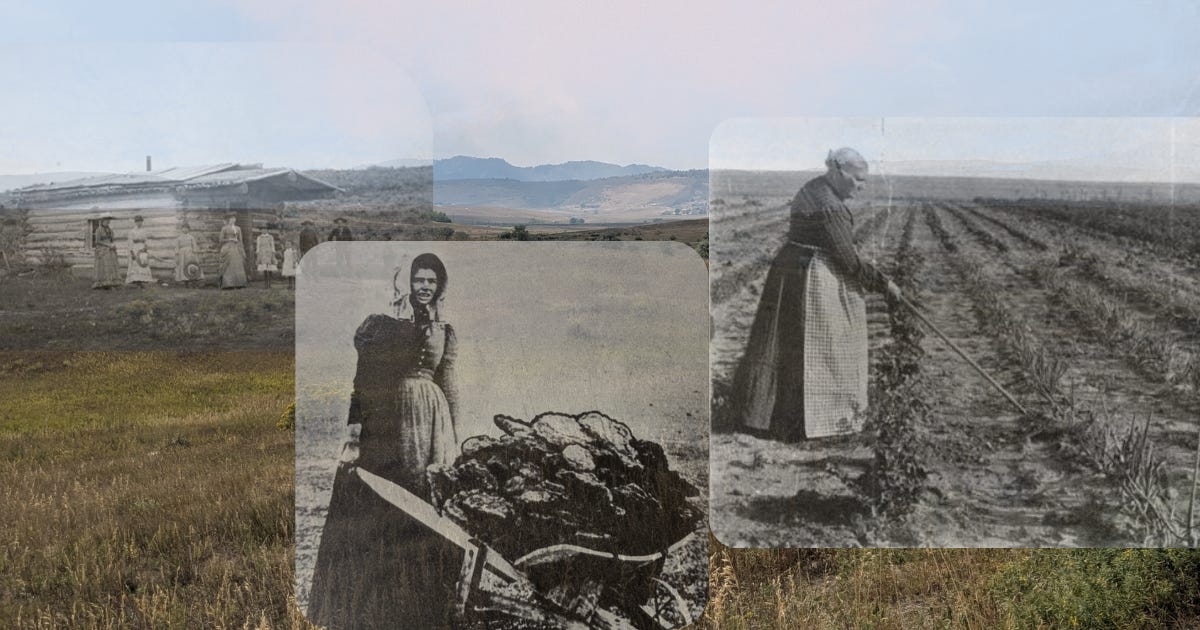
The fireplace that Johnaphene Faulkner’s uncles had built didn’t work right. Every time her aunts got a fire blazing, it scattered sparks and ashes into the house instead of drawing up into the chimney. Cooking was impossible and the whole house smelled like smoke — so her aunts took matters into their own hands and built a separate cookhouse.1
Stories like this fill the stack of books I’ve kept close to my desk over the past year, as I’ve studied the Homesteading Era, a time period between about 1850 and 1930, when Americans pushed west into areas the United States had claimed, purchased, won, and, yes, stolen. These Americans established new settlements and tried to live self-sufficiently on land that often proved to be tough for farming — and the women played a key role, not just in keeping house, but in building up homesteads, farming infertile land, and doing the hard labor required to improve a claim and receive a deed for ownership.
Without women’s strength, homesteading families would have struggled to survive. But to play their part, they had to defy the gender norms of their time.
Back in the urban northeast, industrialization had led to the “notion of separate, gender-defined spheres,” wrote Katherine Harris in Long Vistas: Women and Families on Colorado Homesteads. As commerce shifted away from families producing goods together in the home, men left to earn wages and “women gained control of the domestic environment.” This is when the idea that men should be the breadwinners and women should take care of the home emerged.
Attached to this was the Cult of True Womanhood, a Victorian notion that narrowly defined femininity as submissive, pure, and pious. Within this framework, women were seen as weak, innocent beings in need of protection not just from the brutality of life but also from moral corruption (a concept that played largely in debates regarding women’s suffrage).
The idea of separate spheres may have been appealing to women because it gave them some autonomy in the home, but for farmers, it wasn’t an easy thing to live out. And on the frontier, basic necessity pushed men and women outside of their culturally scripted gender roles.
“Everyone was expected ‘to lend a hand,’ and this often led women to perform tasks ordinarily considered outside their sphere,” wrote Sandra L. Myres in Westering Women and the Frontier Experience, 1800-1915. “In more settled areas, hired hands, neighbors, or other family members might have been called in to help, but on the frontier, hired labor was not only expensive but often unavailable; friends and family were far away, and neighbors had their own work. Thus, from the earliest colonial frontiers, women worked beside their men to help clear the land, fell trees, construct a shelter, and plant and harvest crops.”
The work put women’s strength and stamina to the test.
1. Even the simple task of preparing a meal involved hours of hard labor before crops were harvested.
When a family claimed an area of land, the first item of business was planting crops.
“The heavy work of transforming the virgin prairies into cultivated farm fields began as soon as the family was settled,” wrote Joanna L. Stratton in Pioneer Women: Voices from the Kansas Frontier. “Invariably handicapped by poor farming tools and unsophisticated agricultural methods, the homesteaders worked relentlessly to produce enough food and any added income to sustain their families throughout each long year. … Usually, it took the strength of several yoke of oxen and several hardy farmhands to push the plow through the rigid soil.”
In some places, the growing season was a flash in the pan, to use a gold mining metaphor. From May to October or even September in mountainous regions, homesteaders worked daily to ensure they would have enough food to last through the long, frozen winters.
Women were in the fields getting blistered and dirty.
“When the strength of the frontiersman and his sons proved inadequate, the mother and the daughters assisted with the traditionally male tasks of planting and harvesting, tending livestock, hauling water, gathering fuel, and even hunting,” Stratton wrote.
If a woman had a particular knack with plants, she might take the lead, deciding when to plant and how to tend the crops. “One man bragged that his wife could plow as well as he could and since he was fond of baseball, ‘[I] sometimes left my wife home plowing while I went away for a game,’” Myres wrote.
2. Bathing, washing clothes, or just a sip of water meant lugging heavy buckets, sometimes for miles.
On the high plains east of the Rocky Mountains, a vast expanse known as the Great American Desert, water was hard to come by — especially when compared to the lush, humid eastern states that many people were moving from.
A well or a stream was a more reliable source than barrels or buckets left outside to collect rainwater, but they could be a mile or more away. Water often had to be carried by hand to the homestead. As Myres wrote:
Often the men would haul the water for the wash, but when they were engaged at other tasks or gone from home, the women had to do the best they could. Leola Lehman recalled that her mother hauled water for several miles in a little wagon in which she pulled her youngest child and four gallon syrup buckets. Another disgusted housewife, whose husband had not found time to dig a well, lamented that it took so long to haul water “I do not get much else done.”
Some families made a yoke to be carried across the shoulders with buckets of water hung on either end. If each bucket held three gallons, the yoke could easily have weighed 50 pounds. Lifting, carrying, and balancing that much weight over a mile or more was no small task.
3. To be a homemaker, you had to build a home.
Once crops were planted, homesteaders shifted attention to building a house. And women provided much-needed help.
In wooded areas, log cabins were the typical structure, and many women would have helped clear the land and cut and stack the logs. On the plains, where wood was scarce and expensive, homesteaders turned to other materials: if there were hills, they might build a dugout, literally dig a hole in the ground for their home, complete with dirt floor, walls, and ceiling, and the risk that a wandering cow would stomp through the roof.
Others built soddies, or sod houses, made from 50-pound dirt blocks cut from the ground. “Harnessing the strength of several yoke of oxen, they used a special grasshopper plow or sod cutter to slice strips of sod from the earth,” Stratton wrote. “A sharp spade was then used to chop the strips into individual bricks.” The bricks were stacked by hand.
If men had home construction under control, women still contributed in other ways. One pioneer dug a storm cellar while her husband built the house, another helped dig a well, and still another did all the carpentry work in her home:
“Let not ladies lift their hands in horror,” Myres quotes Eliza Farnam as saying. “I laughed whenever I paused for a few minutes to rest, at the idea of promising to pay a man fourteen or sixteen dollars per day for doing what I found my own hands so dexterous in.” She knew that doing the work herself would be scandalous to some women, but it made economic sense — and besides, she was good at it.
More than the mythic domestic pioneer, homesteading women carried on — with or without men.
For homesteading women, reality involved serious, life-threatening challenges — from droughts to plagues to sickness. If a woman’s husband took sick or died or left to hunt or find wage-paying work, she had to carry on without him, manage the entire operation, make sure everything still got done — the animals were fed, the crops planted and harvested.
Some homesteading women didn’t have husbands at all. The Homestead Act of 1862 gave single women aged 21 and older the right to claim their own acreage out west. Somewhere between 4.8 and 18.2 percent of homesteaders (those who filed claims under the act) were women, and according to Sheryll Patterson-Black, as referenced in Long Vistas, women homesteaders were actually more successful in improving the land and patenting their claims than men were, which “discounts the theory of woman as helpless, reluctant pioneer.”
Many single woman homesteaders had family nearby who helped, but they still carried out the heavy work of establishing a home on the frontier. And they experienced a new sense of freedom that was foreign to their mothers and grandmothers, and ultimately helped pave the way for women’s suffrage.2
Looking back, it can be easy to imagine these women as some sort of domesticated stereotype, living an idyllic life off the land where the hard work was handled exclusively by men, but that vision is a fantasy. These women were strong, scrappy, intelligent, and ready to do whatever needed to be done, whether the task was labeled “women’s work” or not.
Previously in Women’s Barbell Club…
The Mother of Feminism Wants You to Get Stronger

This is a long one. Click here to open in your browser.
What Happens When Strength Athletes Switch Gears

Earlier this year, bodybuilder Dana Linn Bailey competed in her first Hyrox. Training for the endurance fitness event felt like a return to her roots as a college soccer player, she said on YouTube. She’s planning to compete in more.
The 🍑 obsession is just another way aesthetics dominate women’s fitness culture

I’ll be honest: I don’t really want to write about butts. I really don’t. I don’t understand the obsession that certain corners of the fitness community have with them, and I prefer to forget that some people ogle others’ behinds.
Recommended Reads
‘Unprecedented’ global effort gives new name to polycystic ovary syndrome — and new hope to millions of women (The Guardian)
Who Are You Getting Your Health Advice From? (New York Times) – This article turned me on to the American Medical Association’s new Health vs. Hype podcast. I recently listened to their episodes on “protein-maxxing” and creatine, and found them super informative.
What weights do you actually need for strength training? (Anna Maltby at How to Move) – This guide is especially helpful for beginners who are trying to put together a modest home gym.
Postscript:
This article is my contribution to the discourse regarding Yesteryear by Caro Claire Burke, a book that IMO did not live up to the hype (though, yes, it’s well-written and yada yada). I wanted more historical fiction and was disappointed that it didn’t deliver that, but there were other issues too. I agree with the following takes:
I was raised in conservative evangelicalism. YESTERYEAR missed its mark. by Amy Colleen at The Pomegranate
The real women of Yesteryear by Leigh Stein at Attention Economy
The opening anecdote was adapted from Westering Women and the Frontier Experience 1800-1915 by Sandra L. Myres.
Western states granted women the right to vote far earlier than the eastern states.
Meredith! This is such a great essay, and I hope it gets the attention it deserves.
Earlier this year I read the historical novel "The Boxcar Librarian," and though I don't remember the exact details, in one scene the librarian visits a homesteading mother and her children, who lost their father/husband years ago. The mother is exhausted and, because the librarian and her team are documenting Western families' stories for a new newspaper, asks the librarian something along the lines of, "Please don't make this look glorious." She was doing rough, backbreaking work on the daily, and she wanted other Americans to see that. Really stuck with me.
Good read. Recommend the book “Cowgirls: Women of the American West” by Teresa Jordan.