

Meet the 52-year-old who makes benching 300 pounds look easy.
Jen Thompson has dominated powerlifting in the bench press since she started competing in 1999.

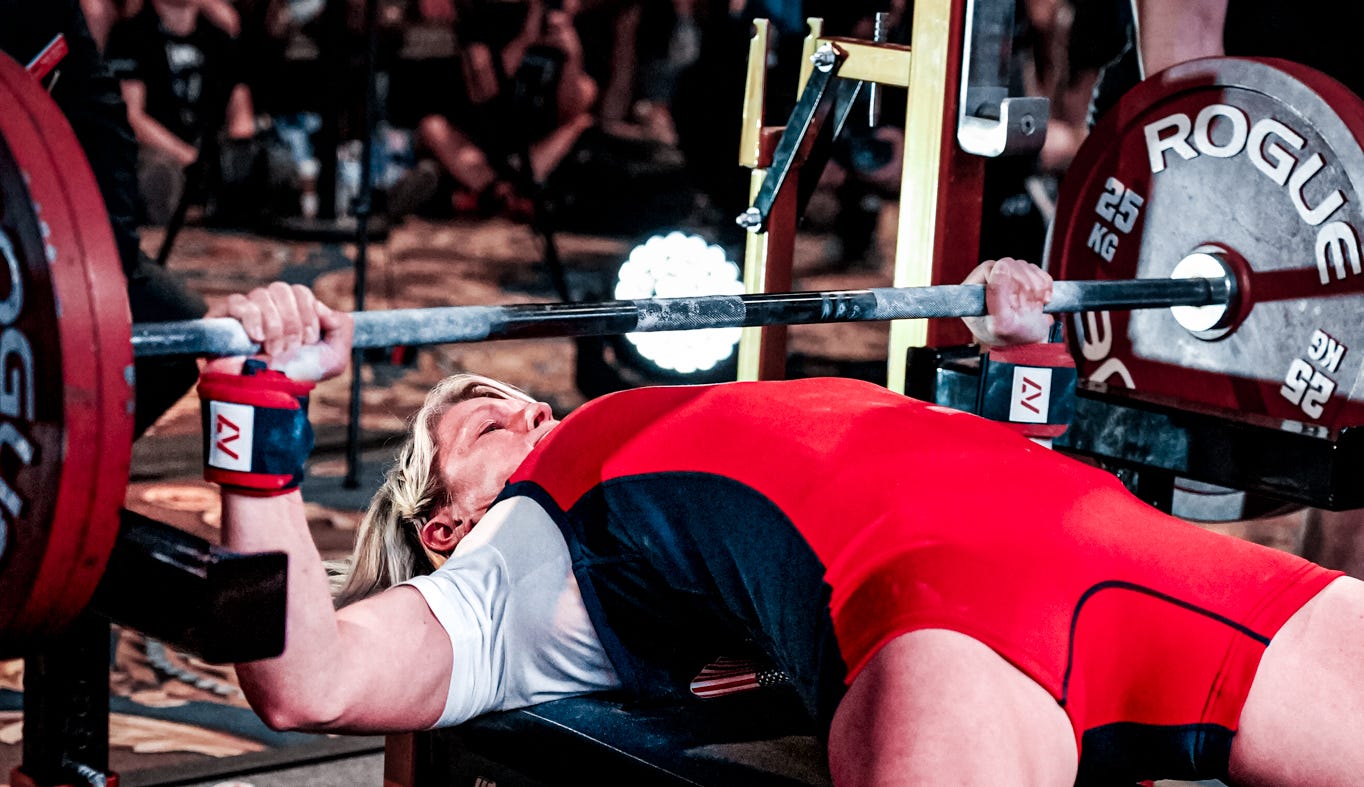
Donovan Thompson’s Instagram is filled with photos of his wife, the world-renowned powerlifter and multiple world record holder Jen Thompson, sleeping. She’s sleeping in the front seat, in the back seat, on planes, on a shuttle, at sporting events, and often in transit from one state or country or continent to another.
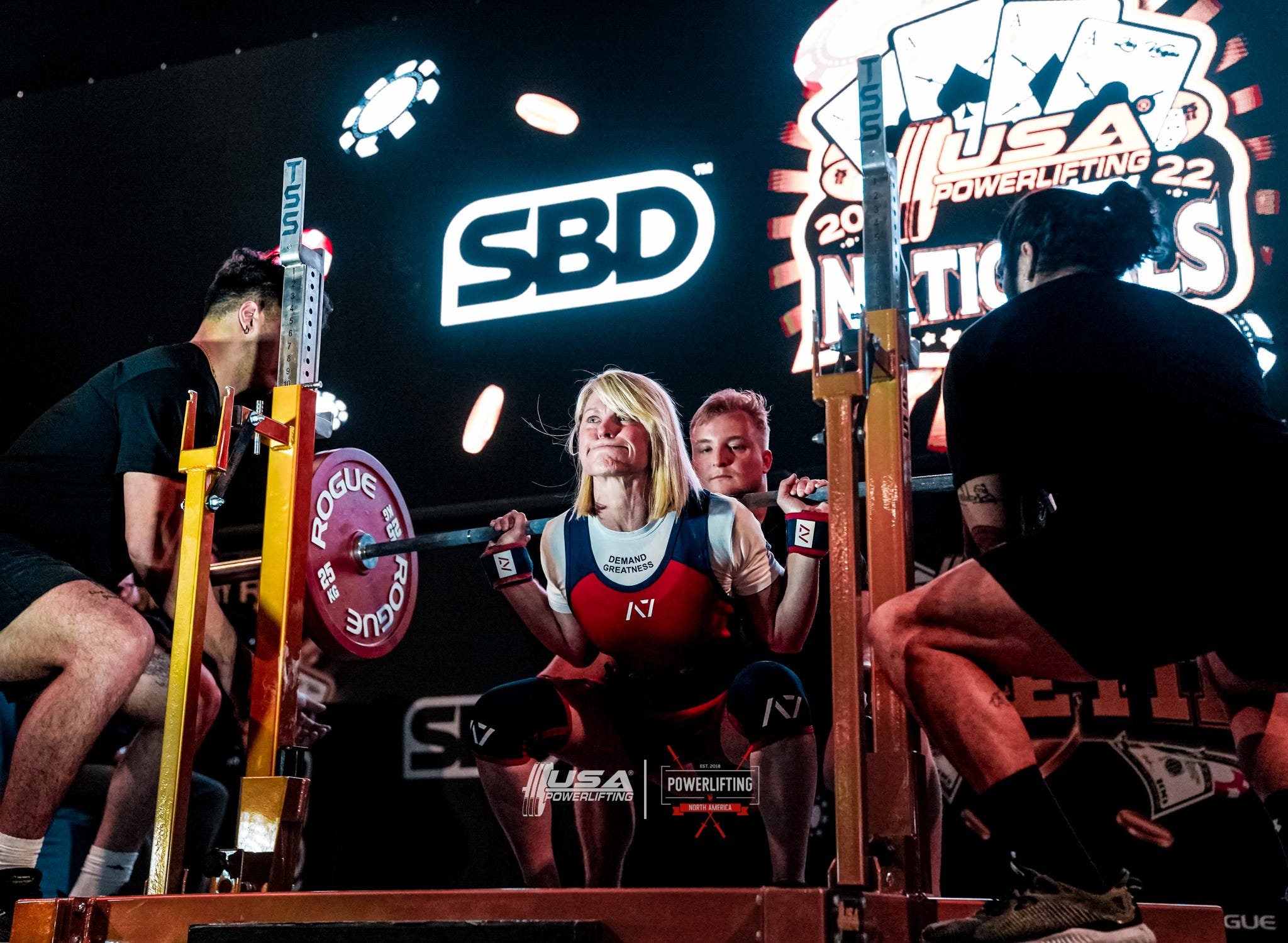
“That’s what she does,” Donovan told me in January. She sleeps. Then he launched into a story of how, in 2022, at USA Powerlifting Nationals in Las Vegas, she took a nap between her first and third bench attempts to recoup some energy since she’d already competed that morning in the bench-only meet.
“She was like, ‘I can’t do six top-end benches,’” Donovan recalled. “I’m like, ‘Well, you’re warmed up. Why don’t you just open with your second attempt [weight], skip your second attempt to give you some rest, and then you can go for the world record on your third?’”
She took his advice: pushed 303 pounds for her first bench attempt, napped through her second attempt, and then moved 320.8 for her third, setting what was then her twenty-fourth world record for the lift.
“There is the adage: you get stronger when you sleep,” Donovan said, and from what he sees Jen do, it seems to be true.
Before Jen was a 52-year-old flaunting her biceps on the internet and making grown men feel weak by casually slinging hundreds of pounds, she was a 5’5” high school long-distance runner growing up in Detroit who made it to state championships for cross country and track not because she loved running (she didn’t), but because, she says, the sport was all about grit, not talent.
She didn’t start lifting weights until college, when she lived in a house with Donovan, who was starting medical school, and two other people. They were all just friends. Donovan, who’s seven years older, had gotten out of the Army five years earlier. In the service, the former lightweight high school wrestler had learned to lift and bulked up from 98 pounds to 150. When he, Jen, and the rest of the crew moved into the house in 1991, he brought lifting equipment that he and some friends had made to order at a fitness showroom. “You couldn’t just buy weight equipment,” he said. “There was one place that had it. You would go in. They had mockups of it, and you’re like, ‘Yeah, I would like a squat rack,’ and they’re like, ‘We’ll weld it up for you.’”
Most days, around 4 p.m., a group of about 10 guys would lift in the basement. They benched Monday, Wednesday, and Friday. Did legs just enough to keep from looking like chickens. Took Sundays off, and then would do it all again.
“They always encouraged me to come and lift weights with them,” Jen said, but she didn’t join right away. It was the early ’90s, and she was mainly worried about putting on the dreaded freshman fifteen. “Back then, skinny was pretty, so you had to very much worry about what your weight was.”
But she’d hear the guys lifting downstairs, laughing together, razzing each other, and finally she decided to give it a try.
“She literally couldn’t bench the bar when she first came into the weight room,” Donovan said. But that changed. At some point, the guys got tired of unloading their weights for her sets. “So we made her lift what we lifted,” he said. “She’s so driven … that every day, she got better.”
Lifting with all guys, the bench was the most important lift. “It was the only thing you cared about, ’cause it was what everyone asked about,” Jen said. “No one cared about squatting or deadlift. Your bench press was the true margin of strength back then.”
Jen didn’t realize exactly how strong she’d gotten until 1998, on a trip with Donovan, now her husband, to Venice, California. They came across a bench press competition on Muscle Beach and noticed that the male athletes were moving the same weight she routinely lifted in her bench sessions.
“You must be pretty strong,” Donovan remembers telling her. Jen talked to some of the competition organizers, found out it was a USA Powerlifting meet, and decided to try the sport for herself. The next year, 1999, she competed in her first powerlifting competition, a local meet in Detroit. She was one of maybe two women.
Looking at her stats from that first competition, it’s clear that she had been benching for years, but not really squatting. She failed her first two squat attempts at 185 pounds, the first because she didn’t squat low enough, the second because she lost her balance and fell into the spotter. “The third one, I think they just gave it to me,” she said. But then she benched, at first failing to move that same weight (185 pounds) and then pushing it successfully on her second attempt. For her third bench, she lifted 235 pounds, setting a state record. Her bench was heavier than her squat.
That first competition qualified her for bench press nationals, and her performance there qualified her for bench press worlds. She set new state records at each competition, moving 237 pounds and 253.5 pounds respectively. She took second place at nationals and third place at worlds.
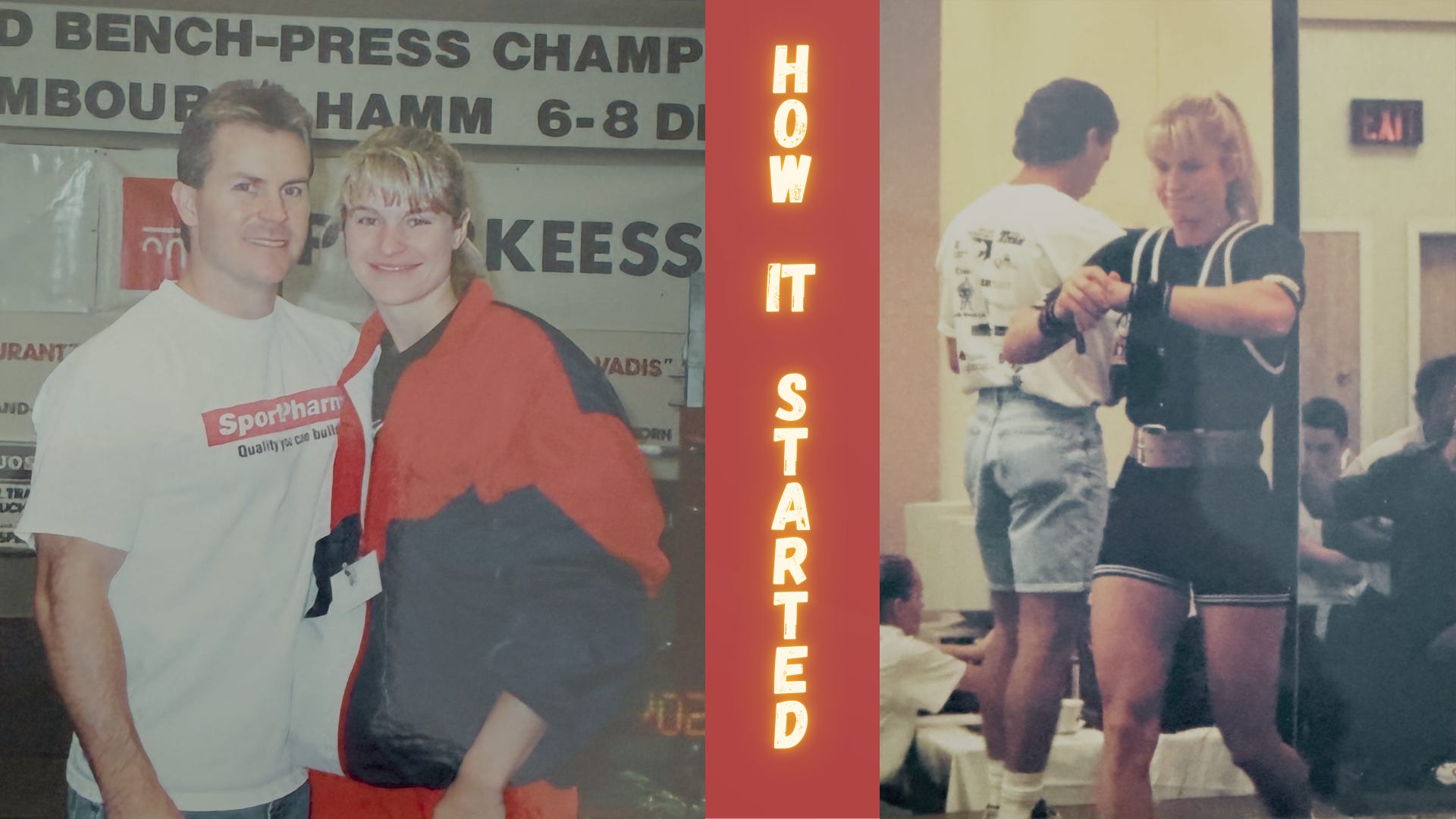
This was all in her first year of competing. Jen was a certifiable newbie who happened to blow her competition (though it was a relatively small pool back then) out of the water. She was still getting nervous during meets, missing lifts because she was stressed about her performance.
She was also struggling to lift in equipment, the ultra-tight garments, like bench shirts and squat suits, that powerlifters wore to move more weight. Lifters would wander around the competition area with their arms out like zombies. “They had their hands sticking straight out from their chest, because the shirts were so tight, you don’t want to put your arms down,” she said. She hated the equipment: “It hurt. When you wore it, it bruised and took your skin away. It really was uncomfortable … and it hurt to try to lift way more weight than you were capable of.” But she used it at meets anyway to keep an edge against her competitors.
In the early 2010s, the explosion of CrossFit led to more people getting involved in powerlifting. About the same time, powerlifting started offering the raw or classic category, where athletes lifted without the skintight equipment.
“[The raw category] is what exploded our sport to where it is today,” Jen says. “And that’s where I found out that I was wicked strong compared to everybody else.”
When she competed in equipment, her bench was in the low 300s. Without her bench shirt, the 132-pound athlete could still move between 280 and 295. While other female lifters were benching 100 more pounds in their bench shirts, Jen was only moving about 30 additional pounds. Strip away the equipment, and her bench was leagues ahead of her competition. At the 2012 USA Powerlifting Raw Nationals, Jen outlifted every other female athlete in the bench, including those from heavier weight classes. Molly O’Rourke, who weighed in at nearly 100 pounds heavier than Jen, benched 264.5, while Jen benched 292.1 pounds. The next closest bench was by Tina Robinson, in the 198-pound weight class, who moved 253.5.
By then, Jen was also moving multiple hundreds of pounds in her squat and deadlift. She’d decided to get better at all of powerlifting. As she raised two sons with Donovan, the couple kept adjusting their workout routine to maximize strength gains, while juggling family and work responsibilities.
Donovan told her early on that she’d need to compete long enough for their kids who see her win worlds: “You don’t want to look [at the medals] and they’re saying, ‘Mom, what’s that?’ … and them never have seen it,” he said. “I know at least five world meets that she skipped ’cause our kids were little, that she would have won, easy.”
In 2006, Jen competed at Nationals less than three months after giving birth to her second son. “She went to Nationals with my son in the car carrier and handed him to one of the other lifters in the front row,” Donovan said. “[She] went and won the bench press, and picked him back up.”
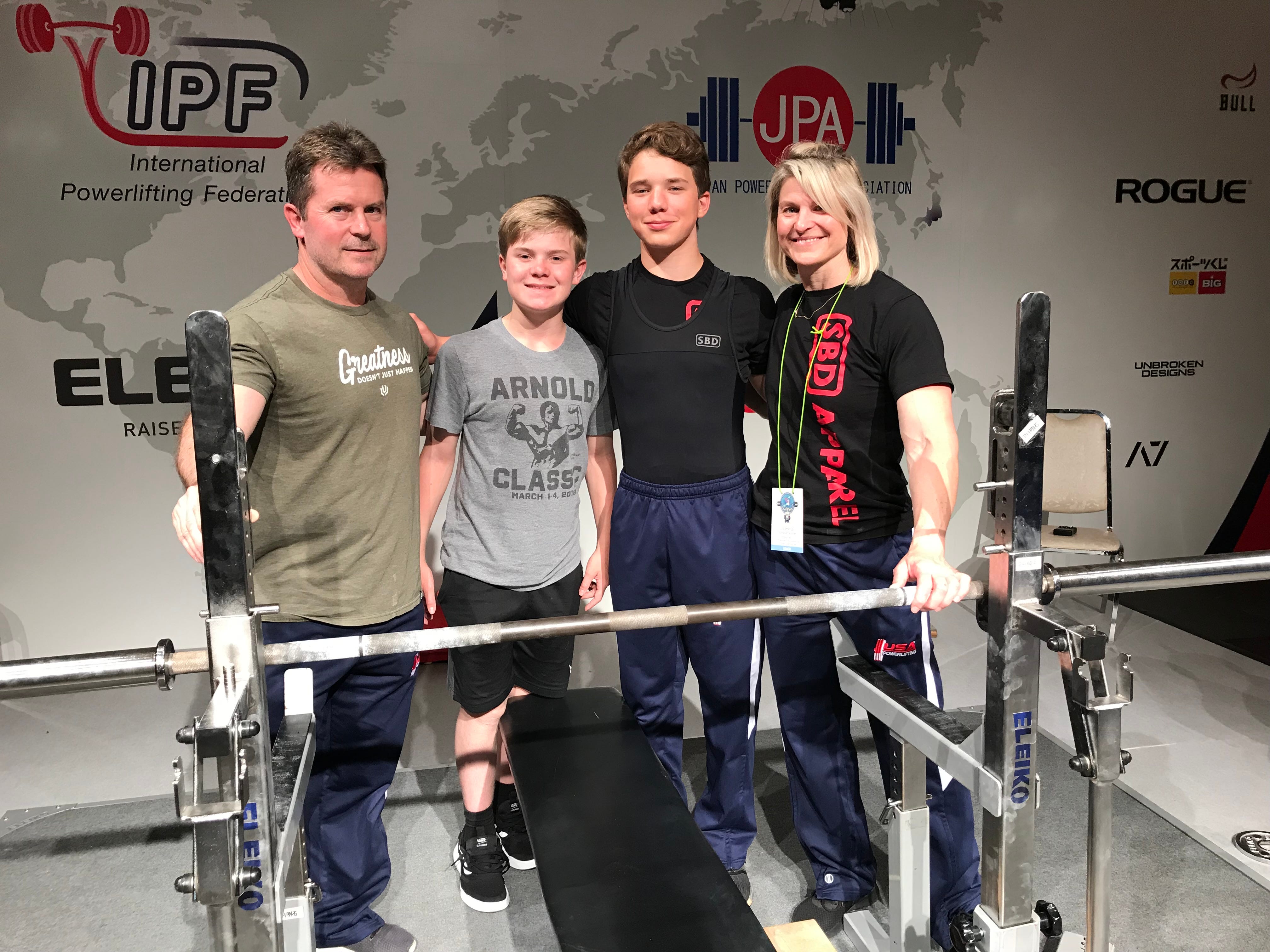
Donovan talks about Jen with a sense of awe. He compares her to Michael Jordan, and points out that she’s won more world titles in her sport than Lance Armstrong has in his (17 to 1).
“She has a world medal in four decades,” he said. “She got her first one in ’99, so for four decades, she’s been good enough to win the worlds. … Will people bench more than her someday or beat her records? I think the answer is yes. But is someone going to win … a worlds in four decades? Is someone going to win 40-some nationals?”
He doubts it.
Donovan serves as Jen’s coach and brings his medical background as an emergency room doctor to his understanding of training. Through trial and error, he and Jen landed on an 8-day training week, with two days on, two days off, and workouts that cycle roughly every 16 days.
He used to think that anyone could train themselves to be world-class in powerlifting, but working with Jen and coaching the USA Powerlifting worlds team changed his mind.
“It’s something in their makeup, something in their ability to drive harder, last longer,” he said. “I’m pretty good at it, but I’m nowhere near her level. And I try. … You just can’t outwork her. It’s impossible. And I know her pain threshold is way higher than mine too. … She tore her ACL, MCL, and had a condyle fracture of her femur — took Tylenol. She had surgery, took Tylenol and iced it. … That’s the kind of pain threshold she has.”
In 2018, Jen competed in the International Powerlifting Federation (IPF) World Classic Powerlifting Championships in Calgary, Canada. She’d missed the competition the year before due to an injury and was back after having hip surgery. “Even though I had won it three years in a row, no one mentioned I was even a contender,” Jen said.
In powerlifting, the deadlift is the last lift to happen and where the most weight is moved. The entire competition pool can be rearranged based on what people lift.
“In that particular event, I was behind,” Jen said, “so Donovan looked at me and he’s like, ‘Let’s just go for all of it right on the second [deadlift] and see what happens.’” She’d lifted 374.75 pounds on her first deadlift. Now, she jumped more than 70 pounds to lift 446.25, a weight she hadn’t yet pulled in her life. “It basically calculated out that [to outlift her] everyone else would be on their PR,” Donovan said, “or [Samantha Calhoun, Jen’s close competitor who’d beaten her at nationals that year] would have to go for a world record on her second attempt.”
“I came out and I pulled,” Jen said. “It was hard, but I pulled it, and then I watched everyone fighting for second [place]. No one even tried to beat me … and there were some girls that definitely could have tried to go after it, but [if they missed] it would’ve meant they were less than second place, so they weren’t willing to risk it.”
Calhoun lifted heavier deadlifts on her second and third attempts, but Jen still won the competition. Added to her squat, her deadlift PR and bench press (more than 80 pounds heavier than Calhoun’s) gave her the heaviest total.
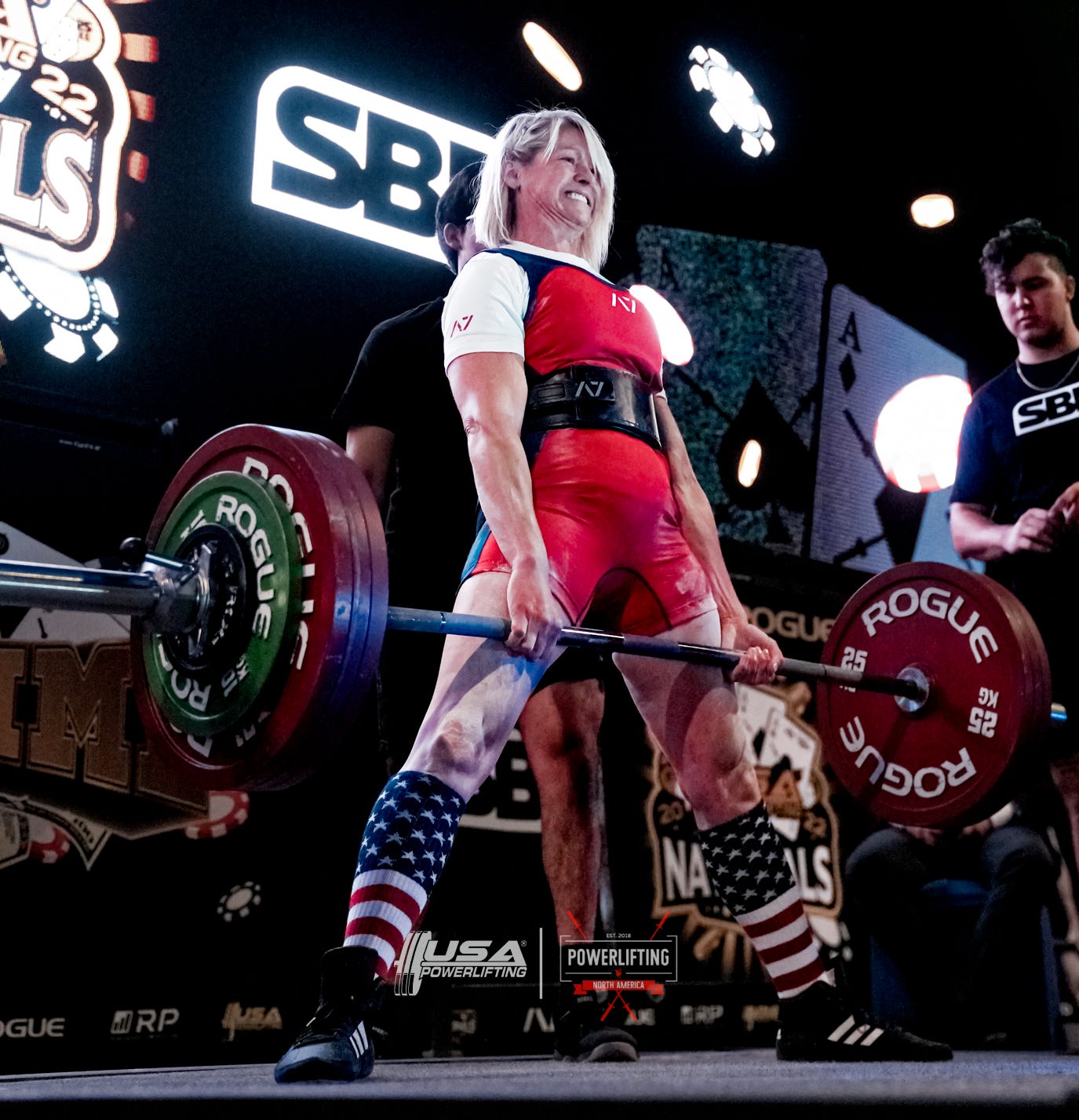
The international powerlifting landscape has changed a lot since then. IPF and USA Powerlifting went separate ways in 2021 due to disagreements regarding testing for performance-enhancing drugs (comment if you’re interested in a deep dive). Thompson, who has passed every drug test throughout her lifting career, stayed with USA Powerlifting and doesn’t lift on the IPF stage anymore. But she continues to compete.
Last year was a lighter year for her. In March, she had her shoulder scoped to clear out scar tissue from years of wear and tear, and after a week off, started working on rebuilding her strength. Then, in August, she tore her rotator cuff while benching.
“I didn’t quite know if I’d be able to bench press again,” she said, but she met with her orthopedic doctor and, rather than going through another surgery, she opted to lighten things up again and develop more of the muscles around her shoulder. In early February, she benched 300 pounds for the first time in almost a year.
“I’ve had a lot of injuries over my career, but you heal, you get on, and I just love [lifting] so much, I never wanted to quit,” she said.
Because of her injury, she’s not expecting to make a new bench PR at her next competition, the Arnold Classic happening March 5–8 in Columbus, Ohio. She’s hoping to bench in the low 300s and then hit a PR or two in her squat and deadlift. The deadlift, fun fact, is actually her favorite lift, and she has a lifetime goal of hitting 460 pounds. “I’ve hit 457.5, but I’ve never hit 460,” she said, “and I feel like this is the day.”
Regardless, she’s sure to move incredible weight.
Previously in Women’s Barbell Club
An Olympian Like the Rest of Us

If you’ve ever wondered how a normal, average Jane would measure up to Olympic athletes on the competition field, Simona Stallone is here to help. This summer, the 27-year-old from Toronto, Canada, set out to attempt as many Olympic-inspired feats as possible, despite the fact th…
Pippi Longstocking is the strongwoman we didn’t know we needed

“And now, ladies and gentlemen, I have a very special invitation for you. Who will challenge the Mighty Adolf in a wrestling match? Which of you dares to try his strength against the World’s Strongest Man?”
What Identity Has to Do with Motivation

Welcome to the fourth installment of the motivation series, where we’re looking at ways we can foster motivation in support of maintaining an exercise routine. You can find the previous installments here.
Recommendations
Because of the Olympics…
Alysa Liu Is Skating Again, Her Way This Time [all the way to the gold!] (New York Times)
PWHL’s influence apparent at Olympics with overtime medal games and the gap closing behind US and Canada (Newsday) I’ve been following the PWHL since their showcase game in Denver brought in a record number of fans. The league is seeking to grow women’s hockey throughout North America and added two new franchises over the last year, with plans for more. This article claims that the PWHL is partly responsible for narrowing the competition gap between nations in women’s hockey.
Lindsey Vonn says surgery saved her from having her left leg amputated following Olympic crash (Associated Press)
I'd love the deep dive too. Thanks for a great article.
I would love the performance enhancing deep dive!