

But what about my muscles? 😢
Injury Diaries. Part Two. Maintaining immobilized muscles.

I know this is a pretty gym bro thing to say, but one of my main concerns with being in a cast or boot for 6-8 weeks is: how much muscle mass am I going to lose?
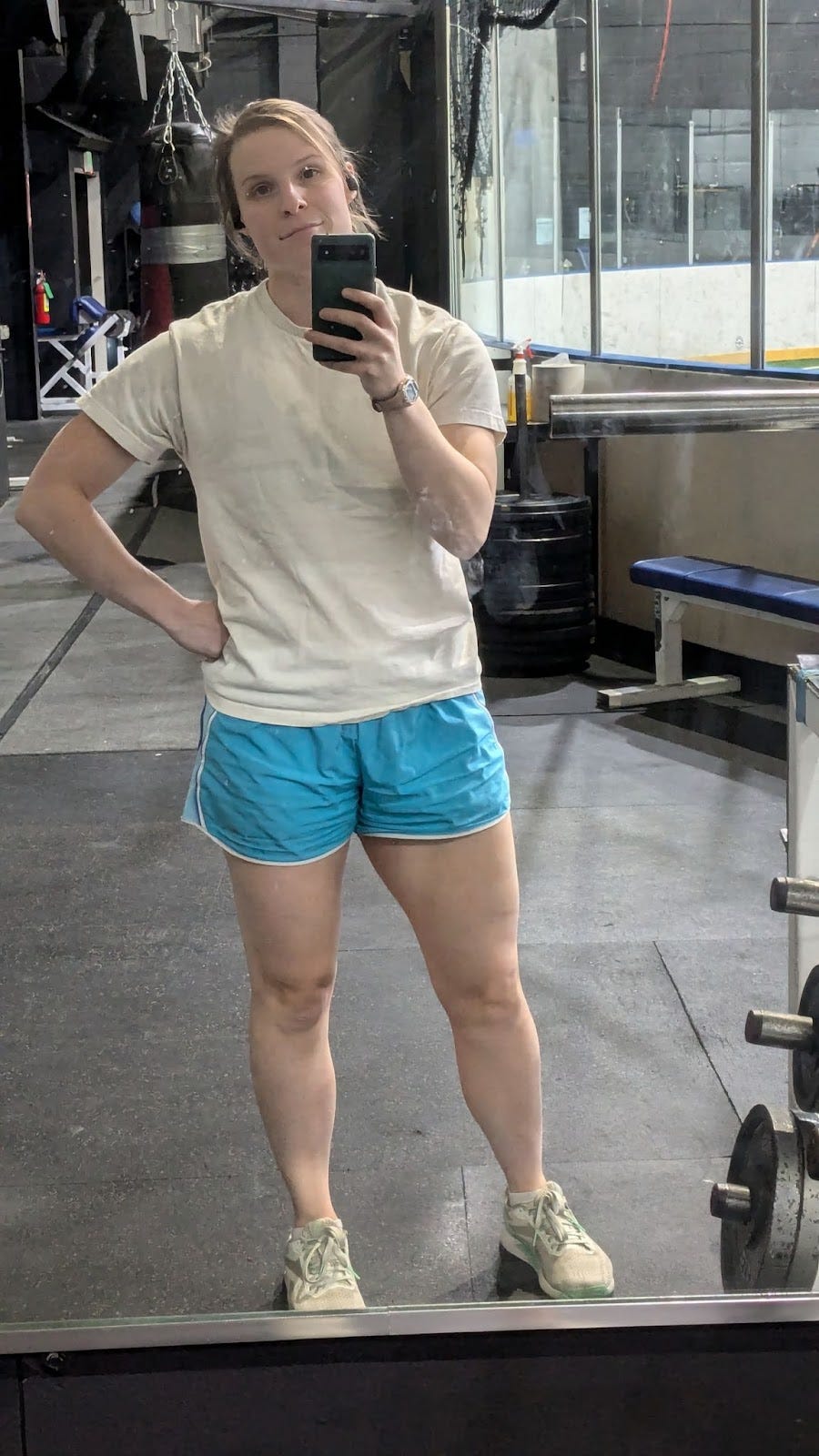
This is me on October 31, almost three weeks before my injury:
According to a literature review published in the European Journal of Sport Science in 2014, the first one to two weeks of inactivity show the greatest relative loss of muscle mass, and “muscle strength declines during disuse at approximately three times the rate that muscle tissue is lost.” I know that I lost some muscle mass (and strength) in the two-plus months between hurting myself and having surgery. I was still able to walk short distances and do bodyweight exercises — lunges, squats, RDLs — but I wasn’t doing any lower-body barbell work and I was keeping reps on the low side to avoid further aggravating my ankle.
Now, since Monday, I’ve been restricted to the couch (mostly), no weight-bearing on my left leg, navigating my apartment on crutches that are way too loud while my nurse-on-night-shift roommate sleeps during the day.
My right leg has been picking up the slack. Every time I sit down, I’m basically doing a pistol squat. At the beginning of the week, I’d fall half the distance to my seat or hold onto the bathroom sink to control my descent. Today (Friday), every one-legged drop to the toilet or couch or kitchen chair has felt more controlled. You’d think as a bona fide strength connoisseur, I’d have the pistol squat mastered, but nope. According to some strength and conditioning pros, I shouldn’t have been squatting a barbell to begin with. You can’t do a pistol squat? You ought to be able to do that first. Ah well, my left leg’s loss is my right leg’s gainz.
I say all that to say: the leg I’m concerned most about shrinking is my left leg. The same leg that has been smaller (noticeably to me) since I was 16 because of the same injury that led to my surgery. Some muscle loss from both legs is inevitable, but how can I mitigate as much atrophy as possible?
When I was discharged, I was given this protocol to prevent blood clots:
Ankle pumps and circles (on good leg) 25 times each hour while awake.
Straight leg raises with 5-second hold, 5-10 reps, three times a day.
Quad extensions by pushing the back of the knee into bed to straighten the leg, hold for 5 seconds, 10-20 reps, three times a day.
Enough activity to keep the blood flowing, but not enough to maintain any significant amount of muscle.
Once I’m fully off of pain meds and in a walking cast (likely to happen this-coming Tuesday), I’m planning to start doing some floor exercises — things like bicycle legs that are done laying on the back — to stimulate more blood flow and keep my quads and hamstrings somewhat awake. There aren’t any activities I can do for my calves while I’m in a cast, so I’ve got to accept the fact that I’ll have some rebuilding to do. But honestly, some atrophy there will probably help me pace myself through the rehab process and not jump too quickly into things my ankle isn’t ready for. I guess that’s a good thing.
Outside of laying-on-the-floor exercises, all I can really do is keep my diet rich in protein.
Why would this help? Our muscles are constantly breaking themselves down and rebuilding new tissue, the same way that our skin is always growing new layers. “On a daily basis 300-600 grams of muscle tissue is being broken down and re-synthesized, theoretically resulting in an entire renewal of an individual’s skeletal muscle within a 3- to 4-month period,” the same literature review says. In a healthy person, the breakdown and rebuilding of muscle is roughly equal. But when we’re inactive, our bodies’ protein synthesis rate (which drives our ability to rebuild muscle) declines, so that the rebuilding of muscle can’t keep up with the breakdown of old muscle tissue. Inactivity may also cause our bodies to not absorb as much of the protein we eat.
To account for this, injured athletes are encouraged to:
Prioritize protein in their diets. This won’t prevent atrophy altogether, but it will alleviate the overall effects of inactivity on muscle mass and strength.
Consume multiple high-protein meals throughout the day. Protein synthesis peaks two hours after eating, so make sure each meal contains a decent amount of protein (at least 30 grams for women, according to Stacy Sims1; 35 grams for men, according to the review). To maximize how much of the day your body is absorbing protein, you could even follow bodybuilder protocol and eat 4-6 small, protein-packed meals. I will not be doing this.
Consume complete proteins (such as whey protein or animal products) or take 2-3 grams of leucine with your other protein sources. Leucine is an amino acid your body can’t produce that plays an essential role in protein synthesis. Omega-3 fatty acids and creatine can also be helpful.
What am I gonna do?
Call it laziness or what I prefer: simplicity. But I generally don’t take supplements. I don’t do bulks or cuts. I don’t mess with my diet to manipulate my body composition. I’m an intuitive eater who trains in a sustainable way with the goal of gradually increasing strength and overall work capacity over time.
I know for a fact that I don’t consume the textbook-prescribed amount of protein. Over a year ago, I tried to increase my protein in breakfast and lunch — my breakfast changes stuck, my lunches went back to my signature turkey sandwich2, which might have 20 grams of protein. I hate protein shakes and every kind of protein powder I’ve ever tried. I think they taste like chalk. And I would rather eat real food than unregulated supplements that are sold at the sketchiest gym bro stores.
So I won’t be adding supplements to my diet in an attempt to attenuate muscle atrophy. Instead, I’m going to eat mostly normally and potentially swap out some of my beloved carbs for my also beloved meat/eggs/cheese/milk, and if I snack, reach for a bag of cashews instead of chocolate chips, maybe pick up some beef jerky. This post, then, might be a shining example of “do what I say, not as I do,” but we’ll see how it plays out.
Recommended Reading
Are Americans Doing Fitness Wrong? (New York Times)
What’s coming next?
More Injury Diaries and/or the pullup guide — no, seriously, I promise I will write about pullups.
Bonus:
Here's a sad little tidbit I came across in researching this edition:
A small study comparing the effects of short-term limb immobilization on men versus women found that women experienced greater decreases in strength (though the change was not matched by greater decreases in muscle mass). The sample size was only 13 men and 14 women, so can’t make any hard-and-fast claims based on the findings, but if this turns out to be true in larger studies, I’m already annoyed about it.
From Sims’ book Roar, page 231. When I referenced this section, I realized it may have been written based on the same literature review. Basically everything I learned reading the review Sims covers in her section on injury recovery.
Seed bread with sriracha mayo, six slices of turkey, colby or muenster or sharp cheddar, cherry tomatoes cut in half, grilled on the George Foreman. If cold, add arugula. *chef’s kiss*
Thanks for tracking this journey. I’ve had a similar experience and approach to fuelling. Looking forward to reading more.
This is pushy of me. I make a self spotter called the Free-Spotter that may help, especially going for 1RM. Shermworks,com